
Lockeford, California
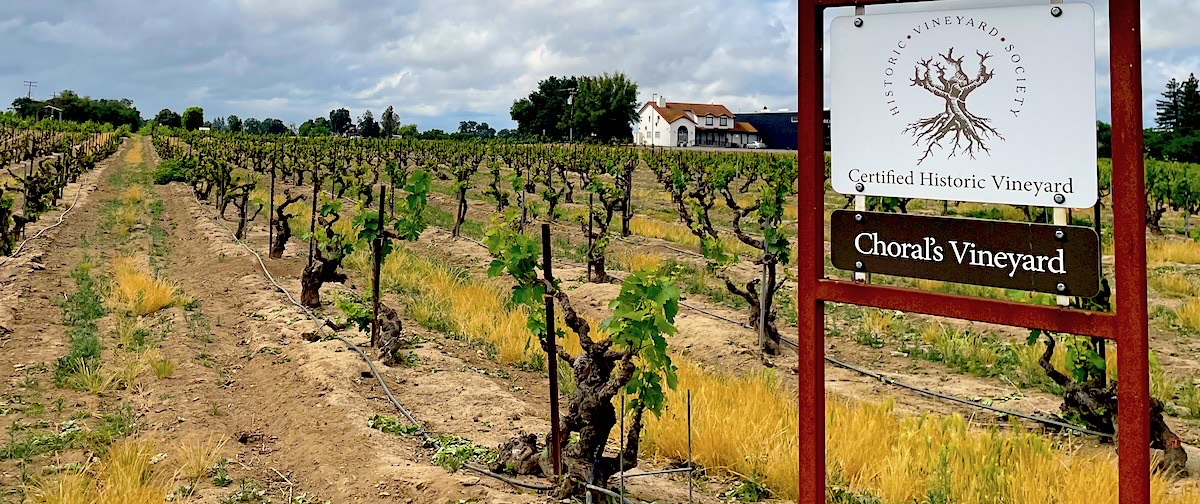
Choral's Vineyard
Old vine Zinfandel planted around 1925, farmed by Jeremy and Choral since 2022. It surrounds our Lockeford winery, so you taste the wine a few steps from the vines.
- Acres of historic vineyard
- 15
- Old vine Zinfandel vines
- 7,105
- First planted
- c. 1925
- Traditional vine spacing
- 10′ × 10′
Eight blocks, eight personalities
Select a block on the aerial map, or read through all eight below.
-
Block 1
Choral's
The oldest block on the property, planted around 1925, with thick, gnarled trunks. Its fruit is the most concentrated and complex we grow.
Oldest vines · Exceptional concentration
-
Block 2
Elevated
A small rise with harder soil. The vines get less water, so the berries stay small and the flavors concentrate.
Harder soil · Natural water stress
-
Block 3
Balance
The classic expression of the vineyard: vine age, soil and microclimate in balance.
Balanced terroir · Consistent production
-
Block 4
Vigor
Younger, more vigorous vines that bring energy and fresh fruit to our blends.
Younger vines · Fresh fruit character
-
Block 5
Dynamic
More vigorous vines that give our wines structure and tannin, a backbone for the concentrated fruit from the oldest blocks.
Structure · Tannin
-
Block 6
Renewed
Harder soils, with younger vines interplanted at higher density for more complexity.
Higher density · Mixed vine ages
-
Block 7
Stoic
A small block on a hard-soiled rise holding some of our very oldest vines, with fruit of real intensity.
Very old vines · Hard soil
-
Block 8
The Field Blend
Our field blend: roughly 60% Barbera and 30% Zinfandel, with Sangiovese and a little Carignane.
Multi-varietal · Grafted in 2023
A century of history
-
c. 1925
First planting
Then known as the Suess Vineyard, the 15 acres were planted to Zinfandel on traditional 10′ × 10′ spacing.
-
1935–1955
Expansion plantings
Small plantings of old white varieties, odd reds and a few unknowns filled the property out to its current 7,105 vines.
-
Early 2000s
Subsurface irrigation
Drip lines were buried 18 inches down to help the old vines through dry farming. Ground squirrels and gophers caused leaks that were hard to find.
-
2022
New owners, modern irrigation
Jeremy and Choral Trettevik bought the vineyard and installed surface drip with digital controls, so the old vines get just enough water to keep the fruit intense.
-
2023
Pruning and grafting
With guidance from Markus Niggli of Markus Wine Co., we test-pruned Block 1 for quality and grafted Barbera buds onto young Zinfandel vines to start a field blend.
-
2025
Field blend expansion
We added 36 Sangiovese vines and some Carignane to the field blend, and cut spurs per vine from the usual dozen or more to 6–8 for more focused fruit.

Anatomy of an old vine
How a century-old, head-trained Zinfandel vine is built, and how we prune it for quality.
-
Trunk
The main structure, thicker and more gnarled every year. Our trunks carry decades of pruning scars.
-
Arms
Permanent woody branches off the trunk that carry each year's growth and fruit, shaped by decades of pruning.
-
Spurs
Short shoots pruned to 2–3 buds. We keep 6–8 per vine for concentrated fruit and better airflow.
-
Canes
The year's green growth from the spurs. Each cane usually carries two clusters.
-
Pruning scars
Every winter's pruning leaves a scar, a living record of nearly 100 years of care.
Taste it where it grows
Our Lockeford winery sits in the middle of the vineyard. Open Thu–Sun, 12–5 pm.